Tuesday, 2 July 2013

Ian Makes an Exhibition of Himself


Ian at Kara Lodge (photo courtesy of Jemima Dury)


The summer of 2013 sees the first major exhibition of the paintings and artworks of Ian Dury.

The exhibition ‘Ian Dury: More Than Fair - paintings, drawingsand artworks 1961-1972’ is being staged at the Royal College of Art, Kensington Gore, London SW7 2EU from 22 July to 1 September (Closed Mondays). Free Admission.

The show has been put together by Ian’s daughter Jemima Dury, ‘former confederate’ Kosmo Vinyl, and one time Stiff Records art director Julian Balme. More than 30 pieces will be on display, most of them coming from the Dury family archive, with some pieces loaned by Ian’s friends, and collectors.

The Royal College is an apposite venue for such a celebration; Ian gradated there on 8 July 1966 with a diploma as an Associate of the Royal College of Art. He went on to teach art at various schools and colleges before forming his band Kilburn and the High Roads in 1971.


Lee Marvin


Ian: “When I was a painter I got good enough to know my limitations. To exactly place myself, and ambition is one of the driving forces of anyone’s creative output and the thought that you’re gonna be the best. You want to rank with your heroes like Renoir. There’s a room at Kenwood with a Rembrandt and a Vermeer and a Frans Hals. Once you’ve done twelve years, which I had, you get to point where you know that however hard you try, fifteen hours a day, you reach a point where you realise you ain’t necessarily gonna be good enough to please yourself. Good enough to spend that time agonising over it. Lucien Freud is always grafting, it’s pure frustration. If you’re prepared to put up with that life, you’ve got to believe in yourself to a very huge extent and I’d sooner fall asleep with a book.”


Princess Rockeberty


Ian: “A lot of us got into The Royal College Of Art.  They called us the Walthamstow Cockneys. A load of us got in - 14 into the painting school, let alone the dress design department.  There was a mass exodus every year into The Royal College for a further three years of jollification. Peter Blake was teaching there, we're good mates.  The kind of work a few of us were into related to being able to enjoy things that were popular rather than going down the bleeding library all the time.”


Hey, Hey Mobile


Ian: “I met Betty, my late first wife, at the Royal College of Art. She was at Newport College of Art. Her dad went to the Royal College of Art in the thirties. Getting into the RCA was the only thing I've aspired to in my life. I spent two years trying to get in. It’s the only achievement I've ever felt, a bit like going to the university of your choice. I’m really pleased I went there, I’m proud of it. I wouldn't have been able to learn about how to live as a person doing what they want to do if I hadn't gone there, allowing your determination and output to control the way things go - my nine and my five.”

At the time of writing, a Kickstarter campaign has been launched to raise the £10,000 needed to ensure that the show goes ahead. Supporters have been asked to donate here:
http://www.kickstarter.com/projects/1996276438/ian-dury-more-than-fair-art-exhibition/

See you there!

Follow Will Birch on Twitter
Will Birch website

Thursday, 10 May 2012

The Great Tortoise Hunt (1962) - previously unseen footage of Ian Dury


Ian Dury with syrup

During his time as a student at Walthamstow College of Art (1959-63), Ian also taught in local schools. It was at Culverhouse Secondary Modern School in South Ockendon that he met fellow teacher Gordon Law. Fuelled by a diet of jazz and poetry, Ian and Gordon would fantasise about making improvised radio shows and films. The Goons were an influence, as was Richard Lester’s The Running Jumping & Standing Still Film (1959), featuring Spike Milligan and Peter Sellers.

Excerpt from The Running Jumping & Standing Still Film

In 1962 Gordon Law acquired a second-hand Bolex 8mm cine camera and suggested that Ian and his friends make a movie. Filming took place on Sundays in the garden of Ian’s home in Upminster, and in fields close to Barry White’s house in Wood End, Brentwood. The troupe consisted of Ian and his girlfriend Pat Few, Barry and Barbara White, Gordon and Ann Law, and Mike Price. At various points in the film Ian’s mimicry of silent movies legends such as Charlie Chaplin and Oliver Hardy is effortless.

EXCERPT FROM 'THE GREAT TORTOISE HUNT':


Gordon Law: ‘The films we tried to make were incredibly chaotic because each person who took part had an entirely different view of what the films were about. Ian was dressed either as a gun-slinging sheriff or a New York taxi driver with a special leather flat cap. Ian was a crack shot, one-handed with an air rifle in those days. He could hit an Old Holborn tin in the garden from the attic window of Waldegrave Gardens at maybe 100 feet plus.’ 

Barry White: 'We went to Waldegrave Gardens and I remember Ian’s caravan in the garden. It was his studio cum living quarters. Reading between the lines, I think his mum realised she had produced someone who was rather special and she was extremely supportive. It didn’t surprise me when Ian became a star - the signs were there when we made the home movies.’


Ian Dury with titfer and salmon

With special thanks to Barry White, who provided me with the 1962 film on video, from which I was able to transfer it to a digital format for editing and upload. The six minute clip shown here has been edited down from the eleven minute original. Some jolly piano music has been added to enhance the viewing experience.

Postscript: Ian’s mother Peggy actually had two tortoises – Homer and Chloe. I’m not sure which of them has the cameo role in The Great Tortoise Hunt, but it is safe to assume that no animals were harmed during filming.

Visit Barry White’s website:
http://www.barry-white.net/


Follow Will Birch on Twitter
Will Birch website

Saturday, 1 October 2011

Ian’s Old Muckers #4: Humphrey Ocean


“I never grew out of painting. It’s a rather Jesuit idea that people are formed in some way by the age of seven. They go to school and look over their shoulder and see somebody doing it and the teacher says, ‘That’s good.’ And you look at your thing and it’s all thumbs. I do remember when I was about eight or nine I did a black charcoal drawing of a tree with snow on it. One or two people liked it and that was enough for me. I left school at 16 and went to art school. I told my father I was going to be an interior designer. I’d never have dared say to my father I wanted to be a painter, but I was painting away.”

“Having done two years at Tunbridge Wells and then a year at Brighton, I applied to Canterbury College of Art, which was where I met Ian. He arrived the same week as I did, September 1970. He came limping in, in this fantastic cardigan, and made me see that what I wanted to do, which was paint things that I liked, was the most modern activity that I could possibly be involved with. When Ian walked into the room seven questions sprang to mind. His body became part of the room and the dynamics would change. I can remember sensing that immediately - what in other circumstances would have become love at first sight. I thought ‘he looks interesting.’ Ian used to love Victorian watercolour painters - John Frederick Lewis - people like that. He adored the highly detailed pictures, but that was a kind of perversity.”


“You couldn’t help but notice his disability. I had a friend at Tunbridge Wells who had a bad stutter. We used to draw together. That was our rebellion. I don’t go round with a cast of disabled friends, but it occurred to me later that where I would run for a bus, Ian couldn’t, so I would think, ‘well, we’ll wait for the next one.’ It was a frame of mind that I liked. It slowed one down. Ian tried to help and guide us. He would find something to talk about. But he only did it [teach at Canterbury] for two years. He resigned.”

“The reason I’m an artist is because I quite like being on my own. It’s quite a slow business, the art game. I was attracted by somebody who was forced to go at his or her own speed. They actually couldn’t physically outrun themselves. Of course, if Ian had wanted to be a runner, it would have been a disability. He said in one interview that when he became famous he felt emasculated. He couldn’t go out and be loud. For the first time in his life he felt disabled. But actually, you realise that it didn’t hamper him. He moulded the world into his own likeness.”

As told to Will Birch, May 2001. Photographs: Humphrey Ocean as a Kilburn by Ed Baxter. Humphrey and Will by Terry Lott.

Visit Humphrey Ocean’s website:

Follow Will Birch on Twitter
Will Birch website

Thursday, 1 September 2011

Ian’s Old Muckers #3: Terry Day


“I started at Walthamstow during Ian’s third year, I think, 1962. In October 63 we started at Royal College of Art. I was into abstract but my work was reality based, car dumps, crashes, landscapes. There was a disused motorbike they had thrown out by the entrance. I lugged it in, cleaned it up and painted it. All the brown-coats lugged it back out and I lugged it back in. Ian was into the dolly birds, Laurel and Hardy, 6B black pencil drawings. I have one in the attic.”

“When we got to the Royal College we were a bit of a double act. We would operate. What we shared was the infinite thing, drumming. ‘Come and see these drums.’ That always was our bond, there was no competition, a double stroke roll was what he wanted to hear. Ian loved the social thing, but for me it was music. Anonymity didn’t exist for Ian. I didn’t want minders round me, but Ian needed one.”


“Ian only became a magnet when he set up the group [Kilburn and the High Roads], not before. He was a partial magnet or a provisional magnet at Canterbury when he was teaching. As soon as he started the second phase, he became a full magnet. Put it like this… Ian wouldn’t have had a lot of social visitors prior to the second phase of Kilburn and the High Roads. He would have friends but not a lot of people around him. Thereafter his social magnetism increased, from Wingrave onwards. With the Kilburns, as soon as Dave Robinson entered the game Ian became a magnet. He enjoyed being famous. He may have had a period where he had to get used to it, but he enjoyed it. He wanted it. But when you get to the top of the mountain it takes it out of you. From stepping out onto the street with anonymity – the musicians might know who you are – but the difference is, as soon as you’ve got a face, people are watching you.”

As told to Will Birch, March 2004. Photographs: Terry with Humphrey Ocean looking on by Terry Lott, Ian and Terry courtesy of Terry Day.

Visit Terry Day’s website:

Follow Will Birch on Twitter
Will Birch website

Monday, 1 August 2011

Ian’s Old Muckers #2: Chaz Jankel


“From my perspective, being quite candid about the latter days of Ian Dury and the Kilburns, it had run its course. Ian was tired. It had gone as far as it could go. We were one of the top pub acts but it needed to go to another level. I felt that the band could only take Ian so far artistically. Ian used to write a lot with the keyboard players. I was a keyboard player as well as a guitar player and I was actually looking for a lyricist, but I got a whole lot more - I got Ian Dury - an amazing character. It was natural for me to want to write with Ian. We talked about the idea of backing off playing live and writing an album. He was in his flat near the Oval and I used to go there with my Wurlitzer piano and a guitar and write songs.”

“The very first lyrics were Tell The Children and Sex And Drugs. Wake Up was in the second wave, it got us started on ‘New Boots’. Ian’s flat was amazing. He had a fairly frisky relationship with Denise, [they were] both very spirited, and they didn’t always see eye to eye. There was a very delicate dance of wills taking place. Denise was very gregarious.”

“A lot of Ian’s girlfriends had a boyish look to them, slim and petite. A girl named Zegnia accompanied him around Italy. We used to smile and say hello but I never had an in-depth conversations with any of them. They kept themselves to themselves. She didn’t party with the rest of us. They were an item and would go off to a room somewhere. Ian always needed someone to help him. A girl called Belinda appeared later on, who used to drive Ian nuts, once again quite petite, whimsical, pretty but unpredictable.”


“Ian knew he was immediately recognisable, he couldn’t run away. He didn’t like the vulnerability of fame; at Notting Hill Carnival, Smart Mart and Blake picked him up, one under each elbow and rescued him. He would want a minder with him when he went out. I think there was a disagreement with Fred with regard to the use of ‘restraint’, although Ian would often incite Fred and Fred would end up having to defend Ian. Ian felt strengthened by Fred’s involvement.”

“Ian’s perfect idea of an evening would be a bottle of Moet, champagne cocktails and have Ed Speight sitting next to him, in his little room in Hampstead rolling spliffs and telling jokes. Ed was a bright man with a sarcastic sense of humour. That’s when a lot of his lyrics would come about, quips and couplets on his sketch pad. The ultimate relaxation for Ian, strangely, sadly enough, was when he was diagnosed with cancer. The chemo was knocking the wind out of his sails but it gave him a certain humility, it took the anger out of him and at times it was quite welcome.”

“He’s left an amazing legacy. The Blockheads wouldn’t be together, the spirit hasn’t died. Physically we won’t get any more songs from Ian Dury. Most people of our generation know who he was and are inspired by that bravado. It’s synonymous with the late 70s. He characterised that age for me.”

As told to Will Birch, July 2004. Photograph: Chaz by Terry Lott. Drawing of Chaz by Ian Dury.

Ian Dury: The Definitive Biography Facebook group
Follow Will Birch on Twitter
Will Birch website


Wednesday, 6 July 2011

Ian’s Old Muckers #1: Fred ‘Spider’ Rowe


“When we went to America, I told him, ‘These Americans Ian, they adore you, they love the stories you tell.’ Everywhere we went, the place was jammed. I told him, ‘In Europe and England, you’ve always been able to pull a bird and get knobbing, but in America you ain’t. What’s the reason for that?’ The American birds never went for him. He only pulled two the whole time we were there, and one of them was a bit of a Magnus [Pyke]. I said, ‘That’s a geezer ain’t it?’ He liked them like that. ‘Fuck off,’ he said."

"Me and Davey had a few arguments. Davey used to tell me he was going to give Ian a whack. I told him, ‘You’ll have to give me a whack first and you won’t find that easy.’ In Germany, we were in the hotel and the bloke behind the desk had an Irish [jig] on. Ian pointed it out to me because I’m bald and I won’t wear one. Ian asked him, ‘How much hair you got under there?’ The bloke took umbrage and got the right hump. I said, ‘Allow me to apologise for my friend, he’s drunk.’ But Ian knocked all the stuff off the counter. The geezer leapt forward and grabbed Ian by his scarf. I wasn’t quite quick enough, so I grabbed hold of his hand and wrenched it away from Ian. I thought he was a mug and I didn’t want to hurt him. I was saying, ‘Please don’t make me do it,’ but Ian’s going, ‘Fred, knock him out!’ As I turned to talk to Ian, the geezer’s punched me on the side of the head, so I had to deal with him. He called the police. They spoke to me in English, but when we got to the police station they could only speak German! Peter Jenner had to pay money to get me out of the nick."


"Ian told me that when he was young he should have been kicking a ball about and scrumping apples, but he was put in this institution. It must have been quite bewildering for this affliction to hit him at such an early age. I never noticed it. All I saw was the man, but he used to think that everybody noticed his disability. He had a down on himself. He invented it. I told him, ‘They see you as an artist and a rocker, not a raspberry [ripple]. It’s your talent, not your fucking bodily structure.' He asked me, ‘Do you believe that?’ I wasn’t in the habit of giving him bollocks. He used to thank me. You could up him for a few days, then he’d be on his own. If he never had some old tabby with him to cheer him up he’d go into depression again."

"But he changed my life. I’d never met anyone like Ian before. I had a huge mistrust of people due to my mixing with the criminal fraternity, but Ian made an impact on me. He would say things that were complimentary, then stand back and let you digest what he’d said. When I met him, I thought he was an ordinary bloke writing songs, but he was far more than ordinary. I know for certain that if we hadn’t have met, I would have pursued a life of crime and been back in jail. But I became engrossed in Ian’s world and people like Dave Robinson were suddenly treating me with respect. Ian was the catalyst. He treated me as an equal. I’d never had that before.”

As told to Will Birch, May 2008. Photographs: Fred by Terry Lott, Fred and Ian by Chris Gabrin.

Ian Dury Biography 2010 fan page on Facebook
Ian Dury: The Definitive Biography Facebook group
Follow Will Birch on Twitter
Will Birch website

Wednesday, 1 June 2011

My Old Man – The Tale of Bill Dury, Part 2


Bill Dury as a young man. Photo courtesy of Margaret Webb

Following their marriage in December 1938, Bill and Peggy moved into 1b Belsize Road, the flat that Peggy had been sharing with her sister Molly and occasional visitor Elisabeth. Bill was employed as a bus driver and would often arrive home from work to find his wife and her two sisters involved in some deep intellectual discussion from which he felt excluded. In 1939, with the threat of war with Germany on everyone’s mind, Bill persuaded Peggy that they should consider moving from the middle of London. Bill found some rentable housing in Harrow Weald, to where he and Peggy moved in the summer of that year. Molly came along too.


43 Weald Rise, Harrow Weald, the birthplace of Ian Dury

Ian was born at Weald Rise on 12 May 1942, but within 18 months Peggy had decided to take him to live with her mother in Cornwall, to avoid the bombing in and around London. Bill stayed at Weald Rise and continued to work for London Transport. In 1945, however, he saw an advertisement for a job as trainee chauffeur with Rolls Royce. Before long he was chauffeuring businessmen around England and even across Europe. When Ian contracted polio in 1949 and became a boarder at Chailey Heritage Craft School for disabled children in East Sussex, Bill would often visit his son and turn up in the Rolls Royce.


Bill visiting Ian in Chailey, 1951. Photo courtesy of Margaret Webb

In 1954, Ian passed his eleven plus exams and entered the Royal Grammar School in High Wycombe. Bill, who was now estranged from Peggy and driving for the Western European Union, would often visit Ian at school.


Bill Dury, at the time he was driving for the Western European Union, circa 1963. The BOAC coach terminal at Victoria is in the background. Photo courtesy of Jemima Dury

For the remainder of his life Bill lived alone in small flat in Ebury Street, Victoria, but he and Peggy never divorced. Bill died from acute bronchitis and emphysema on 25 February 1968, aged 62.


A copy of Bill's death certificate

In 1998, in an interview with the Daily Telegraph, Ian described going to Caxton Hall to identify his father’s body. ‘So there’s my old man lying on this purple velvet slate with this strange smile. I knew he didn’t look quite right. I didn’t realise until I cleared his room out that he hadn’t got his teeth in.’ Ian asked Bill’s neighbour if he would mind disposing of his father’s teeth. ‘Everything else was all right,’ said Ian. ‘But I couldn’t touch his fucking teeth.’


Oi Oi!

Ian Dury: The Definitive Biography Facebook group
Follow Will Birch on Twitter
Will Birch website

Sunday, 1 May 2011

My Old Man - The Tale of Bill Dury, Part 1


Bill Dury, posing for the camera. Photo courtesy of Jemima Dury

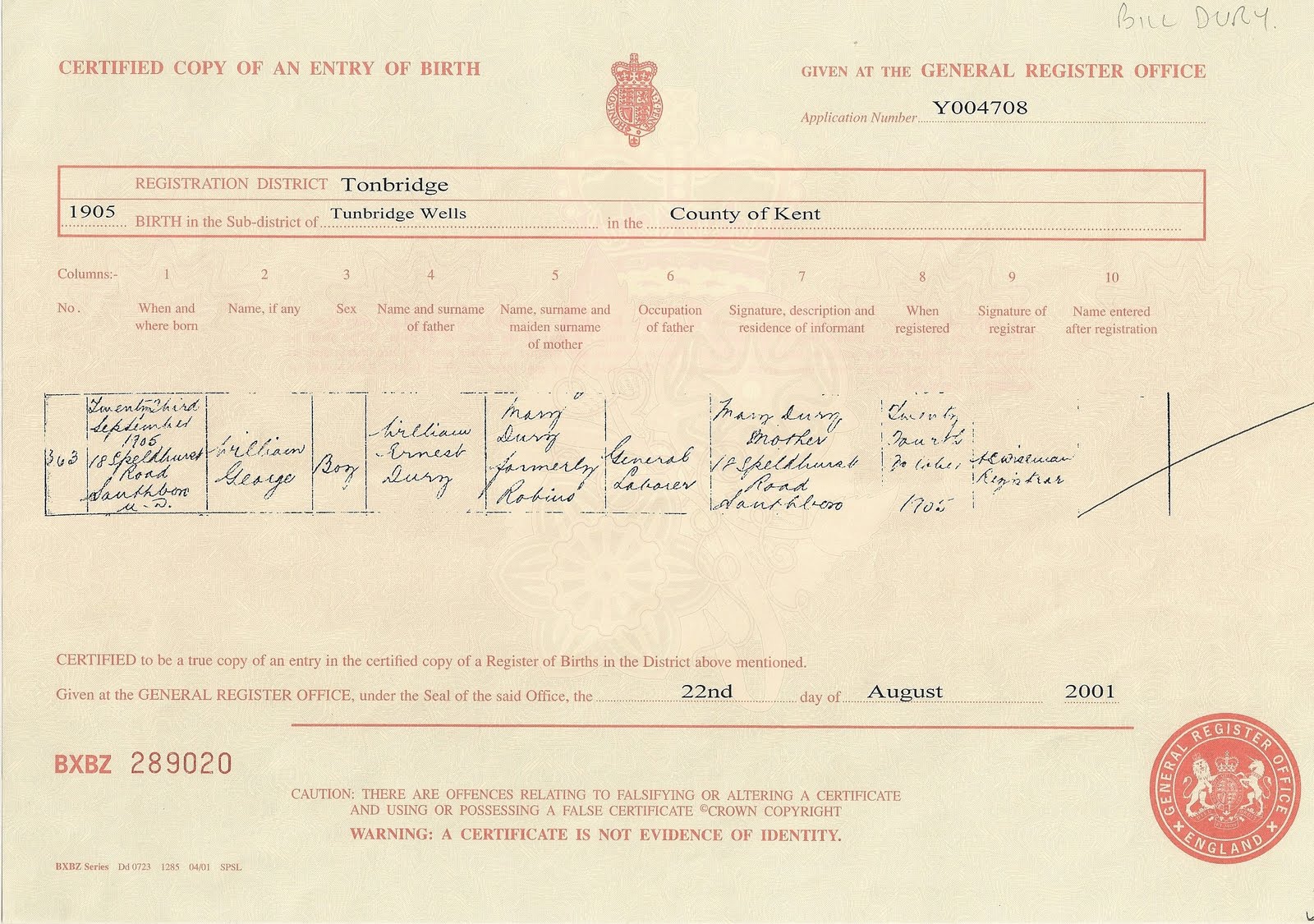
One of the joys of researching Ian’s biography was to uncover little known facts about his family background and, in particular, his father’s genealogy, aspects of which had been a bit of a mystery up until this point. I am of course grateful to Jemima Dury for pointing me in the direction of Ian’s cousin, Margaret Webb. It was Margaret who told me all about the family’s Kentish roots and gave me a few names and places to explore. I soon set off for the (now sadly closed) Family Record Centre in London for hours of fascinating research. Two or three visits yielded Bill Dury’s birth, marriage and death certificates.


Bill was born on 23 September 1905 in Southborough, Kent

Although the certificates provide only scant, yet crucial, detail, with the help of family and friends’ reminiscences and Ian’s own recollections, it was possible to piece together a portrait of Bill Dury, the suave and upwardly aspirational ladies’ man, who yearned to rub shoulders with toffs. Although it is part conjecture on my part, I feel sure that Bill was knocked off his feet when he met his wife-to-be, Margaret (Peggy) Walker. Peggy was descended from a family of wealthy Irish Protestant land-owners. It was quite a contrast to Bill’s working class roots and his occupation of bus driver.


Bill Dury, third from left at back, with work mates at Western National, c.1937. Photo courtesy of Margaret Webb


Bill and Peggy married in London on 23 December 1938, at:


All Souls Church, Loudoun Road, London NW8

The tale of Bill Dury, to be continued...

Ian Dury: The Definitive Biography Facebook group
Follow Will Birch on Twitter
Will Birch website

Saturday, 23 April 2011

‘Ian Dury’ now in paperback, lighter for summer reading


You may wish to know that ‘Ian Dury - The Definitive Biography’ has recently been published in paperback. It is light and portable for easy summer reading and can be ordered from online stores such as Amazon for around six pounds. For true portability a Kindle edition is also available at a similar price.

The content is identical to that of the hardback edition published in 2010, including photo sections, although the paperback is adorned with new artwork and a photograph taken by Chris Gabrin. This replaces the wonderful Peter Blake painting that remains unique to the hardback. There have been a few minor amendments to the text, including the correct spelling of Stirling Moss - previously ‘Sterling’ (although I believe the legendary racing driver may be ‘minted’).

Moss lived opposite the house in Tring that Ian bought for his estranged family in 1979 as soon as the royalties for hit records such as ‘What A Waste’ and ‘Hit Me With Your Rhythm Stick’ started to roll in. Jemima Dury recalled: ‘We moved to Tring because it was near my dancing school and was near Aunt Moll’s. Dad had all the trappings of fame and I was just thinking how quickly you get used to it, but we were still pretty frugal. We didn’t have the monogrammed gates but there were a few trips to Hamleys toy shop for gratuitous purple aluminium skateboards.’

Ian Dury Biography 2010 fan page on Facebook
Ian Dury: The Definitive Biography Facebook group
Follow Will Birch on Twitter
Will Birch website


Friday, 18 March 2011

Mickey Jupp Hi-jacks Ian Dury Blog


Photo courtesy of Pia Meijer

It’s 2011 and Mickey Jupp is standing at the crossroads (again). He recently came out of self-imposed exile to play one tentative show in his home town of Southend-on-Sea, accompanied by demon guitarist Mo Witham, who along with drummer Bobby Clouter has been providing musical support for Jupp for over 45 years. But it’s by no means certain that this isolated appearance signals a permanent return to the planks.

It was a good night at Club Riga. Mickey looked terrified an hour before showtime, but he soon gained composure, opening with Cheque Book (as covered by Dr Feelgood). A number of his own songs followed, including Hole In My Pocket (from Legend’s ‘red boot’ album) and from 1991’s ‘As The Yeahs Go By’, Til Honky Gets Tonky and Standing At The Crossroads Again (as covered by Dave Edmunds).

‘Crossroads’ may be Jupp’s greatest song of the rocking variety, in which he finds himself ‘standing at the crossroads again / with an empty heart and a dollar ten’. A dollar ten! From there he paints himself into a surreal encounter with ‘some famous names – Robert Johnson, Elmore James’ – a genius couplet. Then, in the tradition of the famous blues cliché, he tells us: ‘I woke up this morning’, swiftly followed by ‘as I usually do’. It’s the kind of wry humour that peppers his songs.

A second set opened with Switchboard Susan (as covered by Nick Lowe) and continued with the classic rockers he does so well – Bonie Moronie, Great Balls Of Fire, Sweet Little 16 -  seated at the piano in the same room with more or less the same band he had when I first saw him back in the mid-1960s. We can but hope he will play some more dates. Mo Witham is cautiously optimistic, commenting ‘[Mickey] is even talking about getting a Facebook page, unbelievable!’

Ian Dury Biography 2010 fan page on Facebook
Ian Dury: The Definitive Biography Facebook group
Follow Will Birch on Twitter
Will Birch website

Monday, 14 February 2011

Ian writes a rock'n'roll love letter


As readers of 'The Definitive Biography' will know, Ian dated American girl-about-scene and future legendary punk roots photographer Roberta Bayley when she was hanging out in London in the early 1970s. Roberta had yet to establish her credentials as New York’s leading pictorial chronicler of the early Ramones, Blondie and Television, and Ian was some years away from pop stardom, but in the autumn on 1973 their stars were in the ascendent. Roberta listened to Charlie Gillett’s BBC Radio London show ‘Honky Tonk’ and also worked part-time at Let It Rock, the Malcolm McLaren / Vivienne Westwood boutique in the Kings Road. It was on Gillett’s radio show that Roberta first heard about Kilburn and the High Roads and, with McLaren, went to see the band.

‘I would read through the small ads in the back of the music rags every week,’ Malcolm told me. ‘Primarily for the purpose of looking for pop cultural events that might in some way intrigue me… Kilburn and the High Roads… the idea of calling yourself after the name of a street obviously intrigued me.’

Roberta eventually came face to face with Ian at a Kilburns gig at the City of London Polytechnic in September 1973. They became close friends for a brief period until Roberta had to return to her native America. She had no idea that Ian would bombard her with letters over the next five years. Those letters reveal the inner workings of Ian’s often tortured brain as he patiently awaited success, knowing all the time that he had the musical goods, if not the best method of delivery. However stylish and amusing Kilburn and the High Roads might have been, the band’s musical fragility and ever-changing line-up impaired their chances of commercial success. When Ian wrote the above letter in May 1977, in which he complained about being ‘skint’ and on the ‘rock dole’, he had just found the musicians who would become the basis of the Blockheads and was about to record his breakthrough LP New Boots and Panties!! For Ian, stardom and financial reward were just a few months away.

Ian Dury Biography 2010 fan page on Facebook
Ian Dury: The Definitive Biography Facebook group
Follow Will Birch on Twitter
Will Birch website

Saturday, 4 December 2010

'Ian Speaks' - from the gob of Ian Dury #5


Unpublished gems from the gob of Ian Dury #5. Photo: courtesy of Chris Gabrin

“You’ve got three distinct factions with the Blockheads. You’ve got the Loving Awareness boys, Charley, Norman, Mickey and Johnny, who were a group already. You’ve got Chaz. And you’ve got me and Davey, who were in the Kilburns. There’s a cross-fertilisation of friendships and working relationships. I first invited Davey on stage at Rochester School of Art, the second gig the Kilburns ever did, he was there hanging about. The freedom in his playing has got nothing to do with where Chaz is coming from, so you’ve got different sources. Norman has been on the road since he was 13. Mickey was standby organ player with the Animals when he was 17. They’re steeped in doing it, been in thousands of groups.  What I always found to be miraculous was their attitude. They’d been burnt I don’t know how many times and they still came up for more. When I look at Norman on stage… he plays with Wilko and plays Charlie Parker solos all night! Johnny Turnbull never holds back, his commitment is there, he’s there because he wants to be there. I find that inspiring. Whatever tributaries I may have wandered down, if I write good songs I want them to be with the Blockheads.”

Ian Dury Biography 2010 fan page on Facebook
Ian Dury: The Definitive Biography Facebook group
Ian Dury Biography on MySpace
Follow Will Birch on Twitter
Will Birch website

Tuesday, 2 November 2010

'Ian Speaks' - from the gob of Ian Dury #4


Unpublished gems from the gob of Ian Dury #4. Photo: courtesy of Ed Baxter

“Being older didn’t seem any kind of drawback. At 31 I was quite fond of myself, with what I looked like, I was quite confident about the glamour quotient. I was quite a cocky dick on stage, fearless. In a way, that came across. It’s not until you’re about 36 or 37 that age does begin to creep across your boat race. I’d been teaching and Keith said, ‘How old are you Ian?’ I must have been 27. He said, ‘Ooh, your skin goes like pastry over 25!’ He’d have been about 21 or 22. Plus we were well aware we had a couple of good looking boys in the band. Keith… as long as you cover the spectrum, a couple of loopies and a couple of crackers, you’re alright. I knew I was old, but I didn’t feel it. Charlie Watts is older than me, I’ve known him since 1964. I’m younger than Ringo and I’m younger than Bill, so I’m the youngest on the bill!”

Ian Dury Biography 2010 fan page on Facebook
Ian Dury: The Definitive Biography Facebook group
Ian Dury Biography on MySpace
Follow Will Birch on Twitter
Will Birch website

Thursday, 7 October 2010

'Ian Speaks' - from the gob of Ian Dury #3


Unpublished gems from the gob of Ian Dury #3. Photo: courtesy of Chris Gabrin

“Fred Rowe at the Torrington… I was singing and I saw a brandy glass come flying through the air. Smash! It bounced off me and hit the drummer. Fred’s talking to a girl with large bosoms and didn’t notice it. I said, ‘Fred, a geezer’s just thrown a glass, get up the back, when he moves he’s yours.’ When the number finished I said, ‘I get paid to stand here like a cunt, who threw the glass? Whoever it was better go home now. You all know who he was, send him packing.’ The geezer moved and Fred said ‘Gotcha…’ ”

Ian Dury Biography 2010 fan page on Facebook
Ian Dury: The Definitive Biography Facebook group
Ian Dury Biography on MySpace
Follow Will Birch on Twitter
Will Birch website

Wednesday, 15 September 2010

'Ian Speaks' - from the gob of Ian Dury #2


Unpublished gems from the gob of Ian Dury #2

“When I was at the Royal College of Art there was a bloke in the graphics department who had this book about the Nazis. The back third was sealed with a warning. I wanted to burn the book. I didn’t want it to exist, to be in the world. If you show that image to somebody it will be burnt into their mind for the rest of their life. What good does that do? I’ve got a friend who has to stay out the way a little bit because of his paintings and he had a book called ‘The Encyclopaedia of Sexual Perversions’. It was German, printed in the thirties. There was some innocuous stuff in it, but one photograph of a geezer hanging from a washing line by his bollocks, which were stretched by about two foot. When you turned the book upside down, he had a big smile on his face. Masochism. The book was full of it. I’m glad I’m clean. I don’t want to be tainted by that stuff. Another book, ‘The Encyclopaedia of Murder’ by a bloke called Colin Wilson. There was a bloke in it called Albert Fish who ate kids with sugar. I can’t handle it, I’m a naïve little prat from Upminster.”

Ian Dury: The Definitive Biography Facebook group
Ian Dury Biography on MySpace
Follow Will Birch on Twitter
Will Birch website 

Monday, 30 August 2010

'Ian Speaks' - from the gob of Ian Dury #1


Unpublished gems from the gob of Ian Dury #1. Photo: courtesy of Kees Bakker

"I got invited by Lord Gowrie to be a rock’n’roll… there was me, Pete Townshend and Bob Geldof. They knew the three of us had read a book. We were in the Arts Minister’s office for lunch… I thought, ‘Fuck me what am I doing here?’ Somebody came up to Bob and said, ‘Why don’t you invite Ian and Pete to be on your [charity] record?’ I would have done it, but he never asked me. Bob said, ‘These two haven’t had a hit record for 15 years.’ I couldn’t argue with him. I’m quite glad I didn’t do Live Aid and very glad I didn’t do anything that’s happened subsequently. I don’t actually believe that’s what it’s all about."

Ian Dury Biography 2010 fan page on Facebook
Ian Dury: The Definitive Biography Facebook group
Ian Dury Biography on MySpace
Follow Will Birch on Twitter
Will Birch website

Friday, 16 July 2010

A tale of two books


No one biographer has the exclusive right to his or her subject. The field is always wide open for anyone to tell the story of… in this case, the late great Ian Dury. ‘The Definitive Biography’ – the third full-length Dury book to come out – was published six months ago and has enjoyed healthy sales and good reviews. In 2004, Jim Drury gave us ‘Ian Dury and the Blockheads: Song by Song’, whilst the first book about Ian – ‘Sex & Drugs & Rock’n’Roll’, by Richard Balls, came out 10 years ago, shortly after Ian’s death. All three books are, in my humble opinion, worthy accounts of Ian’s life, but differ in many respects. It is not for me to compare the qualities or otherwise of each book and I relate the following story for amusement purposes only.

When ‘The Definitive Biography’ was announced (it was my publisher’s title by the way), the news reached ‘Sex & Drugs’ author Richard Balls. Apparently, Richard was so incensed by the title that he complained to his publisher, Omnibus, whose commissioning editor, Chris Charlesworth, posted a blog on Rock’s Back Pages in December 2009. You may care to read Chris’s blog and some of the subsequent comments (scroll down to ‘Ian Dury Biography’): http://www.rocksbackpagesblogs.com/author/chris-charlesworth/

Chris, who hadn’t actually read my book when he composed his missive, rightly defended Richard’s book and trumpeted its merits, but cast doubt over whether ‘Definitive’ could possibly live up to its claim, because Richard, Chris suggested, had done all the Dury research that could possibly be done, implying there was no need for another tome on the subject. ‘Richard’s book was… and remains definitive.’

Fight!

Actually, I chose not to rise to the bait. I simply began to spread the word about the imminent release of ‘The Definitive…’ utilising Facebook, MySpace, Twitter, etc (which is all part of an author’s duties in the modern age). Suddenly, after a hiatus of several years, there was a rash of positive reviews on Amazon for Richard Balls’ book. These were from such reliable sources as ‘EM’ and ‘MT’. The latter wrote: ‘this [Balls' book] is THE definitive book on Ian Dury’ – even before ‘The Definitive…’ had been published! One Amazon customer, the mysterious ‘DCD’, even stated: ‘I won't review this book [‘The Definitive…’] as I haven't read it and have no intention of doing so.’

So there!

That’s it really, except to relate that I bumped into Chris Charlesworth this week at a book launch for Zoe Street Howe’s ‘How’s Your Dad?’ Chris was sort of apologetic about his rant on Rock’s Back Pages and wanted ‘to clear the air’. It was Balls, he said, who had voiced his annoyance (over ‘The Definitive…’) and this was what prompted him to post the objection. Chris was also complimentary about ‘The Definitive…’ saying, ‘from the bits I’ve read it’s a damn good read.’


Richard Balls (or 'Ball' as he now styles himself) gave us a book that was well-researched and I admit that I scoured it for clues when writing my own book, ‘as you do’. For the record however, ‘The Definitive…’ offers many exclusive and direct quotes from Ian Dury himself, taken from numerous first hand interviews I conducted (sadly, Balls was unable to interview Ian); it also contains details of Ian’s father’s family background (in contrast to Balls: ‘information about [Bill’s] family background is thin on the ground’); it features a family tree that I researched and drew up, going back five generations; it quotes numerous extracts from letters written by Ian to his muse Roberta Bayley, and includes an interview I conducted with Kilburns’ guitarist Keith Lucas, who until now has remained tight-lipped about his dramatic bust-up with Ian. There are also 35 previously unseen or rare photographs and a beautiful jacket illustration by Sir Peter Blake.

My advice?

Read both!

Ian Dury Biography 2010 fan page on Facebook
Will Birch website

Wednesday, 12 May 2010

12 May: Happy Birthday Ian Dury


In 1941, Peggy fell pregnant for the second time and at 9 a.m. on Tuesday 12 May 1942 gave birth, at home, to a healthy baby boy. Peggy had bought a three-year diary in anticipation of the momentous event, and her entry for the day of birth reads: 'Weight 7lb 6ozs - marked by forceps - slight facial paralysis - Tuesday's child.' Within forty-eight hours, the proud parents registered the birth at Hendon Registry Office and, incorporating Bill's mother's maiden name, called their son Ian Robins Dury.

'I was conceived at the back of the Ritz and born at the height of the blitz,' Ian quipped some fifty-three years later when we met to discuss, amongst other things, his early years. It was a typically colourful couplet to describe his world debut. He went on: 'My mum was a health visitor, and her sister was a doctor, and her other sister an education officer. My dad was a bus driver. He was bright, but he wasn't educated. He left school at thirteen. He came from a long line of bus drivers, as they say. They were proud of it.'

Photograph - Ian aged 3 - courtesy of Jemima Dury


Wednesday, 21 April 2010

Ian Dury: a reading at Southend Library, May 19


I'm off to Southend Central Library on the evening of Wednesday 19 May. They have asked me to read some passages from 'Ian Dury: The Definitive Biography.' I'm currently thumbing though the chapters looking for suitable extracts, maybe with a bit of local colour, but trying to avoid the colourful language - there might be 'librarians' present. It's not easy - every other quote seems to contain an f-word or a c-word, but I haven't hesitated in quoting them at other readings and they usually get a laugh. I'm told there will be 'refreshments' and a Q&A session at the end. They will be selling copies of the book and of course I'll be happy to sign.
The poster above contains ticket details. Hope you can make it, and no arseholes or bastards please. F... C... and P.... are of course welcome.

Ian Dury Biography 2010 on Facebook
Will Birch website

Thursday, 4 March 2010

Ian Dury 12 May 1942 - 27 March 2000

Remembering Ian, 10 years on...

Q Magazine – obituary by Andrew Collins

‘Slightly surreal in death, as in life, Ian Dury shared obituary space in the newspapers with Dr Alex Comfort who wrote The Joy Of Sex’… in Will Birch’s recent account of the pub rock years, No Sleep Till Canvey Island, he concludes that Ian Dury “reaffirmed the spirit of rock’n’roll, and the belief that the underdog could somehow make a mark.” A fitting epitaph, though written before cancer finally bowed him… even [Dave] Robinson couldn’t have predicted that Dury’s death would be an item on Newsnight, front-page news, and cause Radio 4 to re-broadcast his Desert Island Discs… Ian Dury – the poet, the clown, the showman.’

Two years earlier, Ian had been diagnosed with terminal cancer. The tabloids got hold of the story and reporters gathered on his Hampstead doorstep. Ian’s response was to call up two respected journalists he knew, Neil Spencer at The Observer and Janie Lawrence at the Independent and give them the story in an attempt to thwart the tabloids.

Ian: “I told my mate who had come with me, ‘I’ve been diagnosed old son’.”


The Independent on Sunday 10 May 1998 – article by Janie Lawrence

Despite the setback, Ian and the Blockheads completed their new album - Mr Love Pants - their first studio recording in 16 years. ‘What joy to welcome Ian Dury & the Blockheads back into the fold’, wrote David Sinclair in The Times, describing the songs as ‘rich in comic narrative… [with] discreet musical flair and simple human warmth’.


The Times 26 June 1998

21 months later…

The news of Ian’s death broke on the morning of 27 March 2000, making the front pages of most of the national newspapers the following day. In the Daily Telegraph, Neil McCormick wrote: ‘Any list of reasons to be cheerful about British music of the past three decades would have to include Ian Dury, whose always witty, usually exuberant and frequently moving amalgamation of music hall and rock’n’roll made him one of its most unusual and inspirational figures.’


Daily Telegraph 28 March 2000

Obituaries appeared in the broadsheets, many of which incorrectly gave Ian’s birthplace as Upminster, underlining how readily he was identified with the wilds of Essex and a myth of his own making, alongside his cockney persona and underworld dabbling. But despite the minor biographical inaccuracy, all paid tribute to his remarkable lyrics and onstage magnetism and agreed it was a life lived to the full.


The Times 28 March 2000

Ian’s funeral took place on 5 April. ‘We’re gonna have it proper,’ Ian told his friend Jock Scot some weeks earlier. ‘I want the horses with the plumes and the glass-sided carriage.’ Ian got his wish and the traditional funeral cortege turned heads and stopped traffic as it made its way to Golders Green crematorium where the service was conducted by Annette Furley of the British Humanist Association. Mourners included Madness, Mo Mowlam and Robbie Williams.


Evening Standard 5 April 2000

That evening a wake, described on the invitation as an ‘after show party’, took place at the Forum in Kentish Town. Ian wanted ‘an Irish-style wake where everyone gets together and gets pissed.’ That was more-or-less the case, but it was a hugely emotional event with the Blockheads providing the music and guest vocalists including Wreckless Eric, Humphrey Ocean, Baxter Dury and Ronnie Carroll.


'After Show Party'


Read more in ‘Ian Dury: The Definitive Biography’ by Will Birch (Sidgwick & Jackson)